Insights from 5,000 e-commerce customers in the GreenTurn project
When we shop online, we rarely think about what happens beyond the “Order now” button. Yet every click triggers a chain of vehicles, warehouses, and delivery people moving parcels across our cities. GreenTurn set out to understand how e-commerce customers behave along this chain and what would actually convince them to choose more sustainable delivery and return options.
Deliverable D2.3, E-commerce customer journeys, brings together answers from 5,000 online shoppers in Austria, France, Greece, Poland and Spain with insights from retailers active in these countries. The goal: map real customer “journeys” from browsing to delivery and returns, and see where greener choices can fit in without asking people to change their lives completely.
Who are today’s online shoppers?
The survey focused on adults who already shop online and use delivery or return services regularly. The picture that emerges is quite consistent across the five countries:
- Mostly working, city-based and educated. The typical respondent lives in a larger urban area, works full-time (most often in the private sector), and has at least a secondary or higher education.
- Middle income, mid-value purchases. Most earn between €1,001 and €4,000 per month and spend between €11 and €100 online in a two-week period (not luxury shopping, but not the very cheapest segment either).
- Smartphone first. Smartphones and laptops clearly dominate online shopping. Tablets are a useful extra screen, while other devices hardly appear at all.
Altogether, this is a portrait of a fairly digital, financially stable customer who uses e-commerce as a normal part of everyday life rather than an exception.
How do they shop, pay and get help?
Three clear patterns stand out:
- Mobile, fast and simple. People like to browse and buy on their phones, and they expect platforms to be easy to navigate with as few clicks as possible.
- Cards and PayPal rule payments. Credit and debit cards are the number one way to pay, followed by PayPal-type services. Bank transfers and cash on delivery are used, but less often.
- Message-based customer support. Email and live chat are the most popular ways to contact a shop, ahead of phone calls. Customers want flexible, written channels where they don’t have to wait on the line.
All of this confirms one basic message: people are happy to shop online as long as the process feels quick, familiar and under control.
Deliveries and returns: moderate use, low return rates
Despite headlines about ‘serial returners’, the study shows a more balanced reality:
- In the two weeks before the survey, most people placed one to three orders. Only a small minority ordered in very high volumes.
- Returns are rare. Over 80% of respondents reported no returns at all in that period. Those who did return something usually sent back just one item.
- Walking is king for pick-up and returns. When using parcel lockers or pick-up points, the most common way to get there is simply walking a short distance (often under 5–10 minutes). The private car comes second; public transport and cycling are used by smaller groups.
So while e-commerce is widespread, most people are not constantly sending products back and forth. They place a few targeted orders and expect the process – including returns – to stay relatively hassle-free.
What really matters when they choose delivery options?
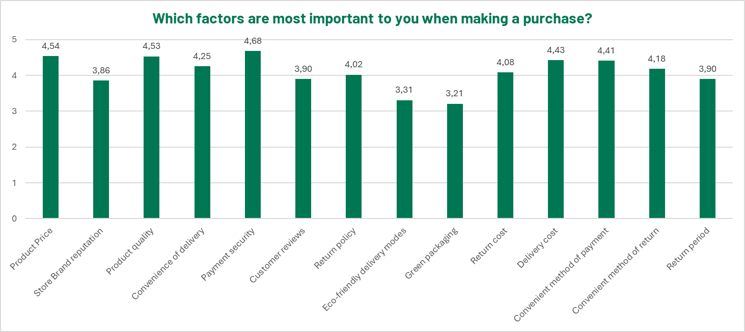
When respondents rated what is important in online shopping, three priorities towered above the rest:
- Payment security – avoiding fraud and feeling safe when paying online.
- Product price – getting a good deal.
- Product quality – receiving what was promised.
Green aspects such as eco-friendly delivery modes or sustainable packaging were not irrelevant. Nevertheless, they still scored above the mid-point of the scale, however they clearly sat at the bottom of the ranking.
This shows that people like the idea of green delivery, but not at the expense of price, safety or convenience. Sustainability is a ‘nice extra’, not yet a deal-breaker.
Six types of shoppers (and three that dominate)
Using the survey and retailer focus groups, GreenTurn validated six main shopper ‘personas’ (simplified types that capture common patterns of behaviour):
- Tech-Savvy Shoppers – confident with apps, digital tools and personalised online shopping features
- Time-Savers – prioritise convenience, speed and simple shopping or return processes.
- Premium Shoppers – look for high quality, exclusivity and a smooth, higher-end service experience.
- Global Explorers – shop internationally to access unique products, while balancing cost and exclusivity.
- Cost-Conscious Shoppers – actively seek value, discounts and good deals.
Among these, three personas are especially widespread across all pilot cities: Tech-Savvy Shoppers, Time-Savers and Premium Shoppers. For each persona, the deliverable builds a customer journey map, which is a step-by-step story from discovering a product to receiving it (and maybe returning it), highlighting where greener solutions could fit in without making the experience more complicated.
If this overview sparked your curiosity, the full deliverable opens up much more: country-specific findings, full persona descriptions and complete e-commerce journey maps that show where real opportunities for greener logistics emerge.
Other events

17 February
Webinar │Customer Journeys and Behavioural Modelling
online
24 September
Webinar: Unlocking Green Delivery: What’s Driving the Preferences of Online Consumers?
Online

6 November
ALICE Logistics Innovation Summit
Tangla Hotel (Brussels)